Brennan: A Legacy of Liberty
By Nat Hentoff
Washington Post Columnist
Tuesday, July 29, 1997; Page A15
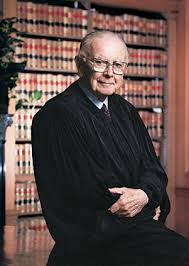
We had been talking about the increasing number of dissents he was writing on the Rehnquist court, and I asked Justice Brennan whether he was getting discouraged. I should have known better. He smiled and said the court had these cycles, but it would come around again. He paused and added, "Look, pal, we've always known -- the Framers knew -- that liberty is a fragile thing. You can't give up."
Then William Brennan quoted from a scene in Yeats's play "Cathleen ni Houlihan": " 'Did you see an old woman going down the path?' asks Bridget. 'I did not,' replies Patrick, who came into the house just after the old woman left it.
'But I saw a young girl and she had the walk of a queen.' "
Justice Brennan looked fondly into the distance. "That passage has always meant a great deal to me."
His conviction remained that the living, evolving Constitution -- not frozen in time more than 200 years ago -- will surely rejuvenate liberty in the decades ahead. After all, despite the best years of the Warren court -- when Brennan was its defining force -- so much had been left undone even then. Let alone since.
Eleven years ago, he said in a speech, "We do not yet have justice, equal and practical, for the poor, for the members of minority groups, for the criminally accused, for the displaced persons of the technological revolution, for alienated youth, for the urban masses. . . . Ugly inequities continue to mar the face of our nation. We are surely nearer the beginning than the end of the struggle."
For all his passionate concern about injustice across the board, Justice Brennan was not a flinty moralist in person. Talking to him, as I frequently did during his last years on the court, I felt entirely at ease in the presence of one of the most powerful figures in the nation. He had no side, as the British say. Genuinely curious about the interests of people he talked to, he was the most naturally friendly person I have ever known.
Brennan was also interested in what happened to some of the litigants in cases he had judged. For instance, Harry Keyishian, an instructor who had been fired because he would not sign a New York state loyalty oath.
Brennan, in that 1967 case, Keyishian v. Board of Regents of New York, had ruled that the loyalty oath and other anti-subversive New York state statutes violated First Amendment protections of academic freedom. Twenty years later, Keyishian was on a televised Bill Moyers series, "In Search of the Constitution." I saw Brennan at the court soon after the program aired, and he was excited at having seen the actual person behind the name on his decision.
"It was fascinating," Brennan told me. "It was the first time I had seen him. Of course, it's rare that I ever see the people in the cases we deal with. Hearing him on the television program, I had no idea that he and the other teachers would have lost everything they had ever done if the case had gone the other way."
To Brennan the law was more than briefs and oral arguments. He may have seen hardly any of the litigants before him, but he searched for a sense of them in the
cases that reached him. Whenever he was asked for his definition of the Constitution, his answer was: "The protection of the dignity of the human being and the recognition that every individual has fundamental rights which government cannot deny him."
That's why Brennan had so deep and abiding a revulsion against capital punishment. Execution by the state, he said, "treats members of the human race as non-humans. Even the vilest criminal remains a human being possessed of
common human dignity."
By contrast, no one on the present court has refused, as Brennan did, to be an accomplice in what Harry Blackmun called "the machinery of death." And it is difficult to imagine that anyone now nominated to the court by a president of
either party could get Senate approval if he or she were against the death penalty.
When Justice Brennan retired seven years ago, he said it was "the saddest day of his life." It was sad for the nation as well, even though relatively few Americans knew anything more about him than his name -- if that.
Brennan, having a quick sense of humor, appreciated irony. He might have savored the president's tribute to him when he died: "Justice Brennan's devotion to the Bill of Rights inspired countless young law students, including myself."
Like Bill Clinton's evisceration of habeas corpus? His persistent devotion to the death penalty? His ardent advocacy of greatly expanded FBI wire taping powers?
Justice Brennan's legacy included none of these, but the president does confirm Brennan's conviction that liberty is indeed a fragile thing.
© Copyright 1997 The Washington Post Company


No comments:
Post a Comment