Appendix 2: Ombudsman of the Judiciary Decision 88/12/Tel-Aviv District, in RE: Judge Varda Alshech
Appeal to Prof. Uri Sivan, President of the Technion, and Prof. Daniel Chamovitz, Chair of VERA, in re: Review of Rachel Ben-Ari's competence as Legal Counsel
In browser: https://inproperinla.blogspot.com/2026/07/2026-07-17-appendix-2.html
החלטת נציב תלונות הציבור על השופטים השופט (בדימוס) אליעזר גולדברג 88/12/מחוזי תל אביב (31.5.2012) בעניין השופטת ורדה אלשיך ("פרשת הפרוטוקולים המפוברקים")


When the affair of Judge Varda Alshech's fabrications exploded in 2011 (about a year after the Net HaMishpat system was introduced for use in the courts), it was considered the most serious judicial corruption scandal in the history of the state. In the meantime, there was the bribery affair in the Judicial Selection Committee, and the Alshech affair was almost forgotten.
One of the important aspects of the affair is the technical detail regarding the Net HaMishpat system, as presented in the decision of the Public Complaints Commissioner on Judges in the Varda Alshech case. This detail is unique, as the system is kept shrouded in heavy secrecy. Nevertheless, one must not take every word as truth, since a central source of the Commissioner is Eilazer—the legal advisor of the Courts Administration. Still, the decision is mandatory reading for every lawyer who appears before the courts in Israel. The situation in which lawyers still do not understand today how the system operates (because the Courts Administration and the judges conceal the details) is a major flaw in the competency of the courts and the legal profession in Israel.
In his decision, the Commissioner clearly describes the flaw and/or central fraudulent practice in Net HaMishpat. The Commissioner determines that a litigant, the lawyer representing him, and the public cannot distinguish in Net HaMishpat between valid and enforceable court documents and "drafts"—documents that have no legal validity whatsoever.
The reason for this situation is that Net HaMishpat implemented concealed electronic signatures. Therefore, there is no way for non-judges to know whether a ruling or judgment is a signed court document—valid—or an unsigned draft—a document with no legal validity whatsoever.
The situation that has arisen corresponds to what is known as a "Shell Game Fraud." The situation in Israel today can be described as a "New Clothes of the Emperor fraud."
If in 2011 one could argue that the implementation of concealed electronic signatures was due to error, that is no longer the case today. Over a decade has passed since the Commissioner's decision in the Varda Alshech matter, yet the central flaw in Net HaMishpat has not been corrected: — the implementation of concealed electronic signatures (if they even exist at all).
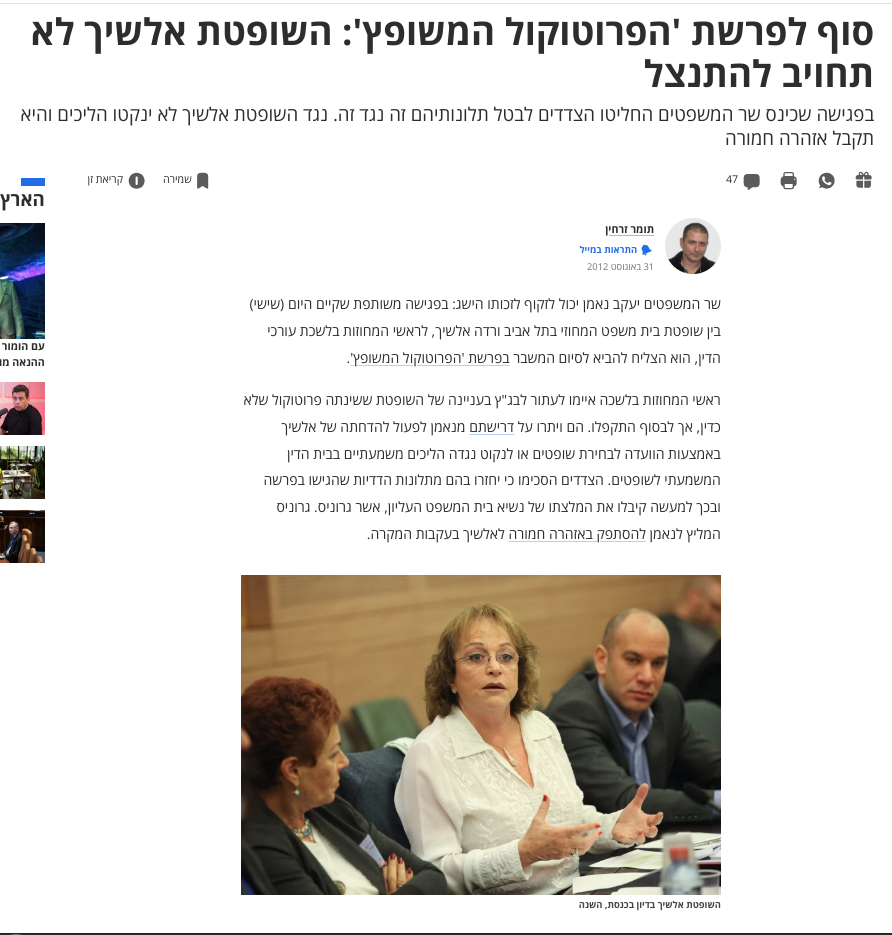
In a just world, the actions of Judge Varda Alshech would be considered serious offenses. Furthermore, in a just world, such actions would not be covered by judicial immunity. These actions are regarded as "extra-judicial conduct," and therefore are not protected by immunity. Indeed, any interpretation that would deem offenses to be part of judicial conduct is patently absurd.
However, in the State of Israel, the reality is different. Throughout the entire history of the state, no judge has ever been convicted of corruption offenses on the bench. There is no shortage of suitable candidates. The inevitable conclusion is that in Israel, judges have been granted impunity for criminality.
Below is a copy of the complete 2012 Decision.
For those who don't read Hebrew, below is a translation of Paragraph 19.
"19. In her responses dated February 5, 2012 and February 12, 2012, Her Honor the Judge stated that there are no two versions of the protocol document. Version A is a "draft protocol" that her secretary mistakenly gave to attorneys Argoz and Arbel at their request, whereas Version B is the "official protocol," which was signed electronically after being proofread by her. From Her Honor the Judge's explanation, it emerges that, with regard to the Net HaMishpat software, every protocol contains a scanned graphic signature of the judge on his/her decisions. However, as long as the protocol has not been electronically signed by the judge, it is a draft protocol located in the software's protocols folder. Only after the electronic signature does the protocol become final. Since the judge's scanned graphic signature also appears on the draft, the printout of the draft and the printout of the electronically signed protocol look identical and cannot be distinguished between them. Therefore, according to the work guidelines, draft protocols should not be printed (as the secretary did), but rather only printed after electronic signature, from the "protocols implementation" folder of the secretariat. Moreover, corrections made to a protocol that has already been electronically signed will create a new version in the system called "corrected protocol," alongside the original version of the protocol. In contrast, for a protocol that has not yet been electronically signed, no versions are saved, and any editing of the document is saved over the same document file. The investigation revealed that in the present case, no previous versions of the protocol were found in the software's "history," but only a single version — Version B, which was attached to the complaint to the Bar Association. As for the actual corrections she made to the protocol, Her Honor the Judge stated that since the hearing was stormy and there were many disruptions during it, the court reporter was unable to type everything that was said. She (Her Honor the Judge) therefore informed the parties that the protocol would be given to them at the secretariat at the end of the day. This case was the last case of that day, so before she rose from her seat, she turned to proofread the protocol, the judgment, and the decisions she had issued during the hearing, so that they would reflect, as closely as possible shortly after the hearing, what was said and decided, while the matters were still fresh in her memory. Despite her announcements, attorneys Argoz and Arbel went down to the secretariat, where they told the secretary that they "came from the courtroom and did not receive a protocol." The secretary, who was under a heavy workload of receiving visitors, mistakenly entered the Net HaMishpat software incorrectly, and printed for them from the protocols folder, which was nothing more than a draft of the protocol. Likewise, and contrary to procedures, the secretary stamped the draft protocol with a "conforms to original" stamp, even though the original was not before her. Not long after she electronically signed the protocol, the secretariat sent the document (Version B — A.G.) in its entirety by mail to the parties. Her Honor the Judge emphasized that not one of the lawyers filed a request to correct the protocol or a request for clarification in order to set the record straight, and they only "remembered" to address this matter after the Bar Association approached Attorney Ergaz. My inquiries to the Director of the Courts regarding the computer aspects of producing the protocol were answered by attaching email correspondence that took place between the computer personnel and Her Honor the Judge, which was sent for my review; by letters sent by Attorney Barak Leiser to the Commission; and by a letter written on February 29, 2012 by Mr. Yarden Yardeni, Project Manager of Net HaMishpat at the Information Systems and Computing Division of the Courts Administration, to Attorney Leiser. In his letter of February 29, 2012, Mr. Yardeni wrote: On the day of the hearing, the court reporter opens a new protocol from the electronic file, an action which opens a new Word document based on a protocol template. In order to begin editing the document, the court reporter must perform two actions within the Word document: "Add attendees"... "


No comments:
Post a Comment