Appendix 2 | Ombudsman of the Judiciary Decision 88/12/Tel Aviv District, in RE: Judge Varda Alshech
https://inproperinla.blogspot.com/2026/07/2026-07-17-appendix-2.html
Index of Appendices and Biosketch, Joseph Zernik, PhD, LLB
https://inproperinla.blogspot.com/2026/07/appeal-for-review-of-rachel-ben-aris.html
Rachel Ben-Ari's competence as General Counsel - Appeal Filed with Prof. Uri Sivan, Technion President, and Prof. Daniel Chamovitz, Chair of VERA and Ben Gurion University President
https://inproperinla.blogspot.com/2026/07/2026-07-17-technion-israel-institute-of.html


Overview & Commentary
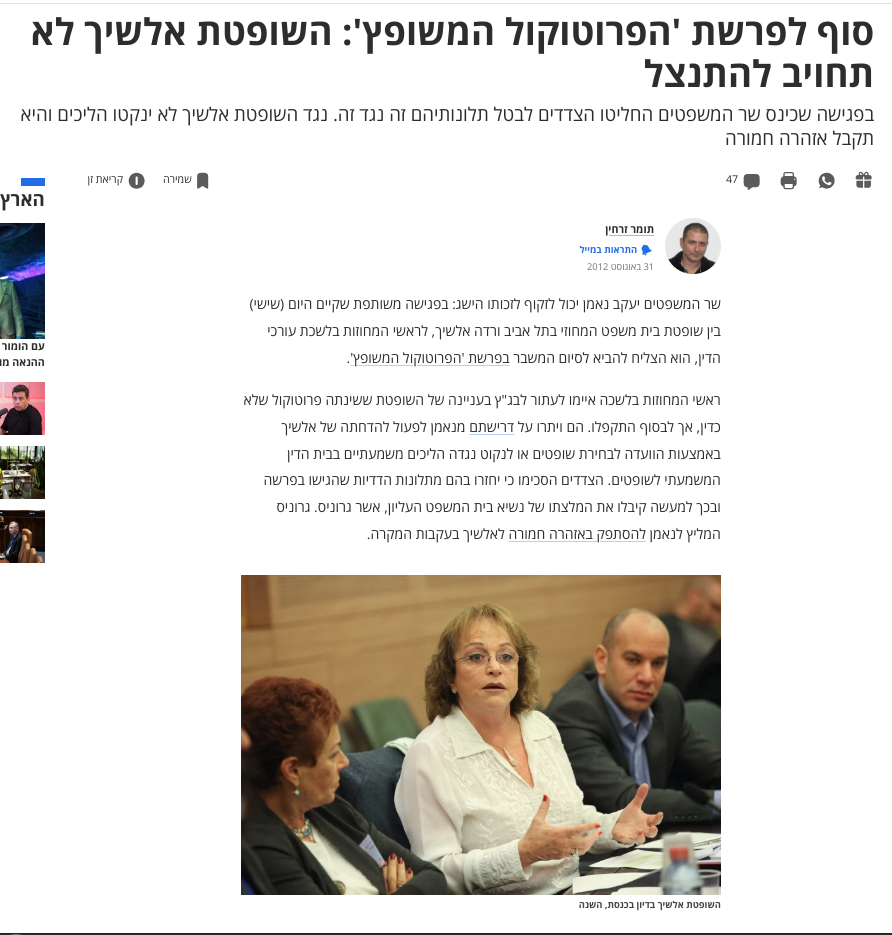
When the affair regarding Judge Varda Alshech's alteration of court protocols emerged in 2011—about a year after Net HaMishpat was deployed nationwide—it was covered as the most serious judicial scandal in the state's history. Mainstream media coverage focused heavily on the personal and ethical breach of the judge's conduct. In doing so, reporting missed—or actively colluded in concealing—the far larger structural story embedded in the Ombudsman's findings.
The Ombudsman's formal decision was classified as "confidential" and was never made public. As a result, the technical revelations regarding Net HaMishpat were kept shielded from public scrutiny.
This document provides a rare look into the system's underlying mechanics. A critical reading of the text reveals that the Ombudsman (retired Justice Eliezer Goldberg) was careful never to make technical assertions on his own authority. Instead, he meticulously attributes every technical claim regarding the system to Attorney Barak Leiser (Legal Counsel to the Courts Administration) or internal IT personnel introduced by Leiser.
By simply recycling the Courts Administration's unverified representations, the decision creates a false illusion of independent verification—leaving the reader with the misleading impression that certified electronic signatures were actively functioning in the system.
Key Technical Findings: The "Concealed Signature" Deception
In the confidential decision, the Ombudsman detailed the central flaw within Net HaMishpat:
Indistinguishability of Drafts vs. Orders: Neither litigants, attorneys, nor the general public can distinguish between valid, legally binding court documents and "drafts"—files that carry no legal validity whatsoever.
The "Concealed Signature" Pretext: The system operators claimed that Net HaMishpat utilized "concealed" electronic signatures—effectively telling the public, "there is an electronic signature here, you just can't see it."
It is now clear that no certified digital signatures existed then, nor do they exist today. What was presented to the public as a technical nuance was, in reality, a classic "Shell Game" or "Emperor’s New Clothes" deception. While one might label the non-existence of verifiable signatures a "design flaw," for those administering the system it served as an ingenious feature—allowing records to be retrofitted, shifted in status, or stripped of legal accountability behind an unchallengeable digital facade.
The ongoing reality in which lawyers operate without understanding how the system actually functions represents a fundamental defect in the competency of the courts and the legal profession in Israel.
Jurisprudential Implications
In a functional legal system, the deliberate fabrication or alteration of court records constitutes extra-judicial conduct falling well outside the scope of judicial immunity. However, domestic practice has historically granted judges effective impunity for conduct on the bench.
Archive Contents
This record contains:
The complete Hebrew text of the 2012 Confidential Ombudsman Decision regarding Judge Varda Alshech.
An English translation of Sections 18–23 of the Decision, covering the technical mechanics and legal status of records within Net HaMishpat.
The Protocol in Net HaMishpat
Date of the Hearing and Editing of the Protocol
On May 6, 2012, I received via electronic mail from Her Honor the Judge a printout from the Net HaMishpat software detailing a list of "events in the protocol" concerning the aforementioned request, which, as stated, took place on September 12, 2011. From the printout, it appears that on the day of the hearing decisions were made by Her Honor the Judge upon the aforementioned request at 09:44 and 09:56. At 10:21 a "recess" event was recorded. At 10:27 a "resumption of hearing" event was recorded, and at 11:27 a "end of hearing" event was recorded.
In his letter dated May 1, 2012, Adv. Lior reported that an inquiry conducted pursuant to the Ombudsman's request revealed that the hearing protocol was first generated on September 12, 2011, at 08:30, and it was opened again for editing on that same day at 10:27.
It can therefore be concluded that after the hearing ended at 10:21, Her Honor the Judge edited the protocol for an hour, between 10:27 and 11:27.
Production of the Protocol
In her responses dated December 5, 2012, and December 12, 2012, Her Honor the Judge stated that there are no two versions of the protocol document. Version A is a "draft protocol" that her secretariat erroneously provided to attorneys Argov and Arbel upon their request, whereas Version B is an "official protocol," which was signed with an electronic signature after proofreading by her.
From Her Honor the Judge's explanation, it appears that as far as the Net HaMishpat software is concerned, every protocol contains a scanned graphic signature of the judge attached to his decisions. However, as long as the protocol is not signed with an electronic signature by the judge, it is a draft protocol residing in the software's protocols folder. Only after the electronic signature does the protocol become final.
Since the judge's scanned graphic signature also appears in the draft, the draft printout and the electronically signed protocol printout look identical and cannot be distinguished. Therefore, according to the work guidelines, draft protocols should not be printed (as the secretary did), but rather only printed after electronic signature, from the "protocols implementation" folder of the secretariat.
Moreover, corrections made to a protocol that has already been electronically signed will create a new version in the system called "corrected protocol," alongside the original version of the protocol. In contrast, for a protocol that has not yet been electronically signed, no versions are saved, and any editing of the document is saved over the same document file. The investigation revealed that in the present case, no previous versions of the protocol were found in the software's "history," but only a single version — Version B, which was attached to the complaint to the Bar Association.
As for the actual corrections she made to the protocol, Her Honor the Judge stated that since the hearing was stormy and there were many disruptions during it, the court reporter was unable to type everything that was said. She (Her Honor the Judge) therefore informed the parties that the protocol would be given to them at the secretariat at the end of the day. This case was the last case of that day, so before she rose from her seat, she turned to proofread the protocol, the judgment, and the decisions she had issued during the hearing, so that they would reflect, as closely as possible shortly after the hearing, what was said and decided, while the matters were still fresh in her memory. Despite her announcements, attorneys Argoz and Arbel went down to the secretariat, where they told the secretary that they "came from the courtroom and did not receive a protocol." The secretary, who was under a heavy workload of receiving visitors, mistakenly entered the Net HaMishpat software incorrectly, and printed for them from the protocols folder, which was nothing more than a draft of the protocol. Likewise, and contrary to procedures, the secretary stamped the draft protocol with a "conforms to original" stamp, even though the original was not before her.
Not long after she electronically signed the protocol, the secretariat sent the document (Version B — A.G.) in its entirety by mail to the parties.
Her Honor the Judge emphasized that not one of the lawyers filed a request to correct the protocol or a request for clarification in order to set the record straight, and they only "remembered" to address this matter after the Bar Association approached Attorney Ergaz.
20. My inquiries to the Director of the Courts regarding the computer aspects of producing the protocol were answered by attaching email correspondence that took place between the computer personnel and Her Honor the Judge, which was sent for my review; by letters sent by Attorney Barak Leiser to the Commission; and by a letter written on February 29, 2012 by Mr. Yarden Yardeni, Project Manager of Net HaMishpat at the Information Systems and Computing Division of the Courts Administration, to Attorney Leiser.
21. In his letter of February 29, 2012, Mr. Yardeni wrote:
"On the day of the hearing, the court reporter opens a new protocol from the electronic file, an action which opens a new Word document based on a protocol template. In order to begin editing the document, the court reporter must perform two actions within the Word document: "Add attendees"... "
and 'Start Hearing'. Until this action is performed, there is no option to edit the protocol document. The 'Start Hearing' action creates a task for the secretariat of 'Apply Protocol'. At the end of the hearing, the typist performs two actions within the Word document: 'Graphic Signature' and 'End Hearing'. The typist, per the judge's instruction, can print a copy of the Word document prior to performing the 'End Hearing' action, so that the parties leaving the courtroom exit with a copy of the protocol. After performing the 'End Hearing' action, the Word document closes and copies a draft into the protocols folder in the electronic file. The judge enters the 'Protocol Application' task and performs an electronic signature from within the electronic file. This action turns the document from a draft to a finalized document, which is locked against changes... The 'Protocol Application' task appears in the task list of the secretariat on the day of the hearing. If a clerk attempts to perform the 'Protocol Application' action before the judge's electronic signature on the protocol, they will receive an alert from the system that the protocol has not yet been signed, and the system will prevent them from completing the application. However, printing a draft protocol via entry to the protocols folder, rather than through the 'Protocol Application' task, in this case no alert that the protocol has not yet been signed will be received.
It is not possible to distinguish between a protocol signed with a graphic signature and a protocol signed with an electronic signature – after the protocol is printed. However, in the Net-HaMispat system within the electronic file there are several ways to distinguish between them: in the signed protocol there is a colored emblem of the State of Israel at the top, which does not exist in the graphic protocol. In addition, the task bar of the protocol in Net-HaMispat is colored green when the protocol is signed with an electronic signature, whereas it is a draft. Additionally, there is documentation for performing an electronic signature in the 'System Protocol Events' folder."
No Electronically Signed Protocol Was Found
22. After receiving the responses of Her Honor the Judge dated December 5, 2012, and December 12, 2012, the Ombudsman received the letter of Adv. Leor to the Ombudsman dated January 3, 2012, and I was surprised to find as follows:
"It was found that there is only one version of the hearing protocol dated September 12, 2011, a version that was not yet signed with an electronic signature in the system ... Under these circumstances, finding only one version of the hearing protocol, which is the subject of the complaint in the system, indicates the absence of a previous version of the protocol containing the judge's signature as stated above" (emphasis not in original).
This matter was also noted in Adv. Leor's letter dated February 27, 2012, to Her Honor the Judge, which he forwarded for my review, noting that "there is only one version of the hearing protocol dated September 12, 2011, a version that was not yet signed with an electronic signature in the system" (emphasis not in original).
This matter was also noted in the letter of Adv. Leor dated April 15, 4.12, according to which "according to the examination conducted, the protocol that is the subject of your inquiry was not signed with an electronic signature ... the hearing protocol is still in the draft folder in the protocols folder."
On March 13, 2012, I asked Her Honor the Judge to address the fact that no version of the protocol signed with an electronic signature exists in the system, and to clarify how this fact aligns with the responses given to the complaints.


No comments:
Post a Comment