Friday, November 22, 2013

13-11-23 Facebook art: US - surge in national resistance


Red Spur added a new photo.

13-11-20 US Misc-news-of-the-abuse: Cops beating student bicycler

Noting more effective than random violence to oppress the People!
___


Police Beat Up College Student for Riding Bicycle on Sidewalk (Video)

By Alyssa Figueroa, AlterNet

A new video shows the 20-year-old student screaming in pain after cops attacked him. 
READ MORE»
http://act.alternet.org/go/40122?t=11&akid=11173.1117888.A9ZqMo

13-11-23 Hello world!

Recent 
11/23 @ 3:04 : Tel Aviv, IL
11/23 @ 2:58 : Los Angeles, California, US
11/22 @ 11:06 : Simi Valley, California, US
11/22 @ 8:24 : São Paulo, BR
11/22 @ 8:18 : San Francisco, California, US
11/22 @ 6:40 : Cambridge, Massachusetts, US
11/22 @ 6:19 : Birmingham, Alabama, US
11/22 @ 5:58 : Mountain View, California, US
11/22 @ 5:50 : Moscow, RU
11/22 @ 5:34 : Angier, North Carolina, US

13-11-22 Tel-Aviv, Friday afternoon at the market square


The weather is close to perfect.  Sunny and cool.
In the front is a football juggler (חנן המקפיץ) behind him, seated, is a local messiah.
And in the back, surrounded by a tight crowd as usual, is Miri Aloni - a 70s flower child singer.  She stood next to Rabin on stage, minutes before the assassination.   The fact that she routinely performs in the street with no security detail is cause for hope.


13-11-22 Origins of Habeas Corpus in the English common law, and US law procedure

As much as I loath Wikipedia, the presentation is interesting, and of particular interest is the Writ of Habeas Corpus, from the 2nd Circuit, Southern District of New York.
As previously suggested, the Writ of Habeas Corpus is indeed originated as a form of Summons, through which the court assumes jurisdiction over the prisoner and the custodian.
The form of the Writ from the NYSD indeed fits this origin.
Has anybody seen any proper Writ of Habeas Corpus in any US court in the recent 20 years?  I have reviewed thousands of cases of Petitions for a Writ of Habeas Corpus, none included a Writ of Habeas Corpus as the commencing record in lieu of summons!
jz
NYSD
We command you that the body of Charles L. Craig, in your custody detained, as it is said, together with the day and cause of his caption and detention, you safely have before HonorableMartin T. Manton, United States Circuit Judge for the Second Judicial Circuit, within the circuit and district aforesaid, to do and receive all and singular those things which the said judge shall then and there consider of him in this behalf; and have you then and there this writ.
_________

Habeas corpus

From Wikipedia, the free encyclopedia
A writ of habeas corpus (English pronunciation: /ˌhbiəs ˈkɔrpəs/Latin: "may you have the body") is a writ (court order) that requires a person under arrest to be brought before a judge or into court.[1][2] The principle of habeas corpus ensures that a prisoner can be released from unlawful detention—that is, detention lacking sufficient cause or evidence. The remedy can be sought by the prisoner or by another person coming to the prisoner's aid. This right originated in the English legal system, and is now available in many nations. It has historically been an important legal instrument safeguarding individual freedom against arbitrary state action.
A writ of habeas corpus, also known as the "great writ", is a summons with the force of a court order; it is addressed to the custodian (a prison official for example) and demands that a prisoner be taken before the court, and that the custodian present proof of authority, allowing the court to determine whether the custodian has lawful authority to detain the prisoner. If the custodian is acting beyond his authority, then the prisoner must be released. Any prisoner, or another person acting on his or her behalf, may petition the court, or a judge, for a writ of habeas corpus. One reason for the writ to be sought by a person other than the prisoner is that the detainee might be held incommunicado. Most civil law jurisdictions provide a similar remedy for those unlawfully detained, but this is not always called "habeas corpus".[3] For example, in some Spanish-speaking nations, the equivalent remedy for unlawful imprisonment is the amparo de libertad ('protection of freedom').
Habeas corpus has certain limitations. It is technically only a procedural remedy; it is a guarantee against any detention that is forbidden by law, but it does not necessarily protect other rights, such as the entitlement to a fair trial. So if an imposition such as internment without trial is permitted by the law, then habeas corpus may not be a useful remedy. In some countries, the process has been temporarily or permanently suspended, in all of a government's jurisdictions or only some, because of what might be construed by some government institutions as a series of events of such relevance to the government as to warrant a suspension; in more recent times, such events may have been frequently referred to as "national emergencies."
The right to petition for a writ of habeas corpus has nonetheless long been celebrated as the most efficient safeguard of the liberty of the subject. The jurist Albert Venn Dicey wrote that the British Habeas Corpus Acts "declare no principle and define no rights, but they are for practical purposes worth a hundred constitutional articles guaranteeing individual liberty".[4]
The writ of habeas corpus is one of what are called the "extraordinary", "common law", or "prerogative writs", which were historically issued by the English courts in the name of the monarch to control inferior courts and public authorities within the kingdom. The most common of the other such prerogative writs are quo warrantoprohibitomandamusprocedendo, and certiorari. The due process for such petitions is not simply civil or criminal, because they incorporate the presumption of non-authority. The official who is the respondent has the burden to prove his authority to do or not do something. Failing this, the court must decide for the petitioner, who may be any person, not just an interested party. This differs from a motion in a civil process in which the movant must have standing, and bears the burden of proof.

Examples[edit]

VICTORIA by the Grace of God, of the United Kingdom of Great Britain and Ireland Queen, Defender of the Faith, to J.K., Keeper of our Gaol of Jersey, in the Island of Jersey, and to J.C. Viscount of said Island, Greeting.
We command you that you have the body of C.C.W. detained in our prison under your custody, as it is said, together with the day and cause of his being taken and detained, by whatsoever name he may be called or known, in our Court before us, at Westminster, on the 18th day of January next, to undergo and receive all and singular such matters and things which our said Court shall then and there consider of in this behalf; and have there then this Writ.
We command you that the body of Charles L. Craig, in your custody detained, as it is said, together with the day and cause of his caption and detention, you safely have before HonorableMartin T. Manton, United States Circuit Judge for the Second Judicial Circuit, within the circuit and district aforesaid, to do and receive all and singular those things which the said judge shall then and there consider of him in this behalf; and have you then and there this writ.

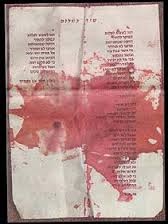
13-11-22 US: Misc-news-of-the-abuse - Handcuffed NC teen ends up shot dead in backseat of cop car

===13-11-22 US: Misc-news-of-the-abuse -  ==
Nothing more effective than random violence to keep the People terrorized!

13-11-22 US: Oakland moves forward with plans for Orwellian surveillance complex


13-11-22 ISRAEL: School kids taught that Prime Minister Rabin was NOT assassinated by a lone gunman...

This morning, Haaretz daily finds an outrage in the fact that kids in some schools were apparently taught that Prime Minister Rabin was NOT assassinated by a lone gunman.  (the piece appears neither in the online nor in the English editions).
It is not clear what is so outrageous about kids hearing the truth from time to time... :)


According to the official narrative, the paper was folded in four in Rabin's breast pocket during the assassination.
However:
a) The paper shows only one bullet hole, not four.
b)  According to the official version Rabin was shot in his back, and the hole in the paper appears as an entry hole, not an exit hole.

Thursday, November 21, 2013

13-11-21 Israeli Supreme Court conducts sham litigation in a case pertaining to incitement for violence against Arabs

[עברית להלן]
13-11-21 “12 of Heshvan et” al v Attorney General Weinestein et al (2684/12 and 2688/12) in the High Court of Justice – conduct of simulated litigation in a Petition for a Conditional Decree // הליכים למראית עין  בעתירה לצו על תנאי י"ב בחשוון ואח נ היועמ"ש יהודה ויינשטיין ואח (2684/12 ו- 2688/12)


The subject matter is of high public policy significance - failure of Attorney General Weinstein to prosecute rabbis, supported by State funds, who call for racist violence against Arabs.
The High Court of Justice conducted litigation process that is outside the Regulations of the High Court of Justice of the State of Israel, or any reasonable standards for operation of a competent court.

In a matter of high public policy significance, the Israeli High Court of Justice is conducting litigation that has no basis in the law of the State of Israel, and would be considered ludicrous by any international standards.
According to the Regulations of the High Court of Justice, the Conditional Decree procedure (where the High Court of Justice exerts original jurisdiction) is to be initiated by the filing of a Petition for a Conditional Decree, in response to which the Writ of Conditional Decree may be issued by the Chief Clerk or Magistrate of the Court (equivalent of summons). Through the issuance of the Writ of Conditional Decree, the Court gains jurisdiction over the matter.
The procedure may end, like other civil cases with the issuance of a judgment, or similar dispositive judicial record.
In the case shown here, the High Court of Justice conducted litigation in two related court files for over a year, and issued over 10 decisions, without ever issuing a writ of conditional decree. In fact, the High Court of Justice was engaging in litigation with no jurisdiction at all.
Finally, on November 20, 2013, the High Court of Justice issued a record that was titled “Judgment” (a dispositive record), and included in its second part a Writ of Conditional Decree (the commencing record).
Under the “Events” listing, numerous “Invitations to Court” are listed, but none is accessible among the online court records.
The case was heard by a panel of three justices of the Israeli Supreme Court, headed by Presiding Justice Asher Grunis, who is advertized as “formalist”.
The conduct of simulated litigation in the Israeli Supreme Court and Israeli High Court of Justice has become routine over the past decade, concomitantly with appearance of an imposter in the office of Chief Clerk: “Chief Clerk” Sarah Lifschitz held office for over ten years with no lawful appointment. During that period, numerous records of the Supreme Court were forged and falsified. All decisions of the Israeli Supreme Court during that period and to this date are published and served “subject to editing and phrasing changes”, and with no authentication letter by the Clerk of the Court.
Following the filing of criminal complaints for fraud and falsely appearance as “Chief Clerk”, Ms Lifschitz “departed” on October 31, 2013.
Request, which was consequently filed with Presiding Justice Asher Grunis, to disclose who today holds that authority of “Chief Clerk” of the Israeli Supreme Court, remains unanswered.
However, in the hearing on November 20, 2013, (regardless of whether it was a lawful hearing or a sham hearing) Ms Aluma Zernik was listed as "Clerk".  Request was filed with Presiding Justice Grunis to provide her lawful appointment record as clerk.
A reasonable person, who would review the facts, would surely conclude that the Israeli Supreme Court is an incompetent court, operating outside the law of the State of Israel, or any reasonable standards of Due Process.
____
Joseph Zernik, PhD
Human Rights Alert (NGO)
Occupy Tel Aviv
____
* The Human Rights Alert (NGO) submission to the Human Rights Council of the United Nations was incorporated into the 2010 Periodic Review Report regarding Human Rights in the United States, with the note: "corruption of the courts and the legal profession and discrimination by law enforcement in California". 
* The Human Rights Alert (NGO) submission to the Human Rights Council of the United Nations was incorporated into the 2013 Periodic Review Report regarding Human Rights in Israel, with the note: "lack of integrity of the electronic records of the Supreme Court, the district courts and the detainees courts in Israel." 
LINKS
[1] 13-11-21 “12 of Heshvan et” al v Attorney General Weinestein et al (2684/12 and 2688/12) in the High Court of Justice – conduct of simulated litigation in a Petition for a Conditional Decree // הליכים למראית עין בעתירה  לצו על תנאי בעניין הספר "תורת המלך"
http://www.scribd.com/doc/186168025/
[1] 11-12-19 Simulated Records Simulated Litigation Enabled by the Electronic Record Systems of the Supreme Court of the State of Israel
[2] 00-00-01-84 Regulations of the Israeli High Court of Justice - 1984 // 1984 תקנות בג"ץ
[3] 13-10-15 Criminal fraud complaint filed with Israel Police against Presiding Justice of the Supreme Court Asher Grunis // תלונה פלילית על הונאה הוגשה למשטרת ישראל נגד נשיא בית המשפט העליון מר אשר גרוניס
[3] 12-04-16 Criminal fraud complaint (158921/2012) against SARAH LIFSCHITZ of the Supreme Court of the State of Israel, filed with Israel Police, with certificate of complaint by the Fraud Division of the Jerusalem Police// תלונה פלילית (158921/2012) על הונאה הוגשה למשטרת ישראל נגד "מזכירה ראשית" של בית המשפט העליון הגברת שרה ליפשיץ
[4] 13-11-06 ISRAEL: Supreme Court Presiding Justice Asher Grunis is asked to disclose - who today holds the authorities of Chief Clerk? // ישראל: נשיא בית המשפט העליון אשר גרוניס התבקש לגלות, מי מחזיק בסמכויות המזכיר הראשי?
[5] 12-05-10 Human Right Alert, Appendix I to Submission; 15th UPR - State of Israel - "Integrity, or lack thereof, of the electronic record systems of the courts of the State of Israel"
[6] 13-11-22 Letter to Israeli Supreme Court Presiding Justice Asher Grunis, re: Appearance of Ms Aluma Zernik as "Clerk" //  מכתב לנשיא בית המשפט העליון אשר גרוניס בנידון: מינויה של הגב'  אלומה צרניק כ"מזכיר".
http://www.scribd.com/doc/186296786/


עניינה של העתירה לבג"ץ הוא ספר "תורת המלך", שלטענת העותרים הוא בבחינת הסתה גזענית לאלימות.  העתירה מבקשת לאכוף על היועץ המשפטי לממשלה לפתוח בתביעה פלילית נגד המעורבים בפרסומו של הספר.
בג"ץ עוסק בעניין זה בהליכים שאין להם בסיס בתקנות בג"ץ, ושאינם סבירים בשום אמת מידה לפעילותו של בית משפט כשיר.
בעניין בעל חשיבות ציבורית רבה, מנהל בית המשפט העליון הליכים שאין להם כל בסיס בחוקי מדינת ישראל, ושקרוב לוודאי ייחשבו בטלים ומגוכחים על פי אמות מידה בין לאומיות.
על פי תקנות בג"ץ, הליך צו על תנאי (בו זכות השיפוט של בג"ץ היא ראשונית) מתחיל בהגשת עתירה למתן צו על תנאי, שהוא מסמך הפתיח (commencing record). בתגובה, יכול בג"ץ להנפיק צו על תנאי, חתום על ידי המזכיר הראשי או הרשם, שהוא למעשה הזמנה לבית המשפט.  על ידי הנפקת הצו על תנאי רוכש בית המשפט את זכות השיפוט בעניין.  ההליך אמור להסתיים על ידי הנפקת מסמך סופי  (dispositive record), כגון פסק דין. 
במקרה שלפנינו דן בג"ץ במשך כשנה וחצי בשני תיקי עתירות והנפיק יותר מ-10 החלטות, ללא הנפקת צו על תנאי.  למעשה, בג"ץ עסק בהליכים למראית עין - ללא זכות שיפוט כלל.
לבסוף, ב-20 לנובמבר, 2013, הנפיק בג"ץ מסמך "פסק דין" (בד"כ מסמך סופי בהליכים). אולם בחלקו השני של ה"פסק דין", מופיע לבסוף "צו על תנאי" - מסמך שהיה אמור להיות מסמך פתיח להליכים אלה.
תחת "אירועים" נרשמו "הזמנות לבית המשפט" - אולם אין בית המשפט מאפשר את גישת הציבור לאף אחת מהן במערכת המקוונת.
התיקים נדונו בפני מותש של שלושה בראשותו של נשיא בית המשפט העליון אשר גרוניס, שכלי התקשורת מפרסמים אותו כ-"פרמליסט"...
ניהול הליכים למראית עין הפך לעניין שבשיגרה בבית המשפט העליון בעשור האחרון, במקביל להופעתה של מתחזה כ"מזכירה ראשית".  הגב' שרה ליפשיץ הופיעה יותר מ-10 שנים כ"מזכירה ראשית" של בית המשפט העליון ללא כתב מינוי כחוק.  במשך תקופה זאת זוייפו ושובשו רבים מכתבי בית המשפט העליון.  כל החלטות בית המשפט העליון בתקופה זאת, ועד היום, מתפרסמות ומומצאות "כפוף לשינויי עריכה ונוסח", וללא כל כתב אוטנטיקציה על ידי מזכירות בית המשפט העליון.
לאחר שהוגשו תלונות פליליות במשטרת ישראל נגד הגב' ליפשיץ על התחזות והונאה, נודע כי "פרשה" ב-31 לאוקטובר, 2013.  אולם נשיא בית המשפט העליון אשר גרוניס סירב לענות עד עתה - מי מחזיק היום בסמכויות המזכיר הראשי של בית המשפט העליון?  
אולם בדיקת הכתבים בעתירות בנידון ספר "תורת המלך" מראה שבדיון ביום ה-20 לנובמבר, 2013 (בין שהיה זה דיון כחוק, ובין שהיה זה דיון למראית עין) נרשמה הגב' אלומה צרניק כ"מזכיר".  בקשה הופנתה לנשיא בית המשפט העליון להציג את כתב מינויה של הגב' צרניק כ"מזכיר".
אדם בר דעת, שיבדוק את כלל העובדות בעניין, בודאי יגיע למסקנה שבית המשפט העליון פועל מחוץ לחוקי מדינת ישראל, ואינו בית משפט כשיר כלל על פי אמות מידה של הליך הוגן.
___

דר' יוסף צרניק
מאהל המחאה החברתית, ת"א

סייג לזכויות האדם (NGO)
____
* דוח סייג לזכויות האדם נכלל בדוח התקופתי של האו"ם לגבי זכויות האדם בישראל (2013), עם ההערה: "חוסר יושרה בכתבים האלקטרוניים של בית המשפט העליון, בתי המשפט המחוזיים, ובתי הדין למוחזקי משמורת בישראל".
* דוח סייג לזכויות האדם נכלל בדוח התקופתי של האו"ם לגבי זכויות האדם בארה"ב (2010), עם ההערה: "שחיתות בתי המשפט ומקצוע עריכת הדין בקליפורניה".
=קישורים =
בעקבות הכתובים באנגלית באנגלית